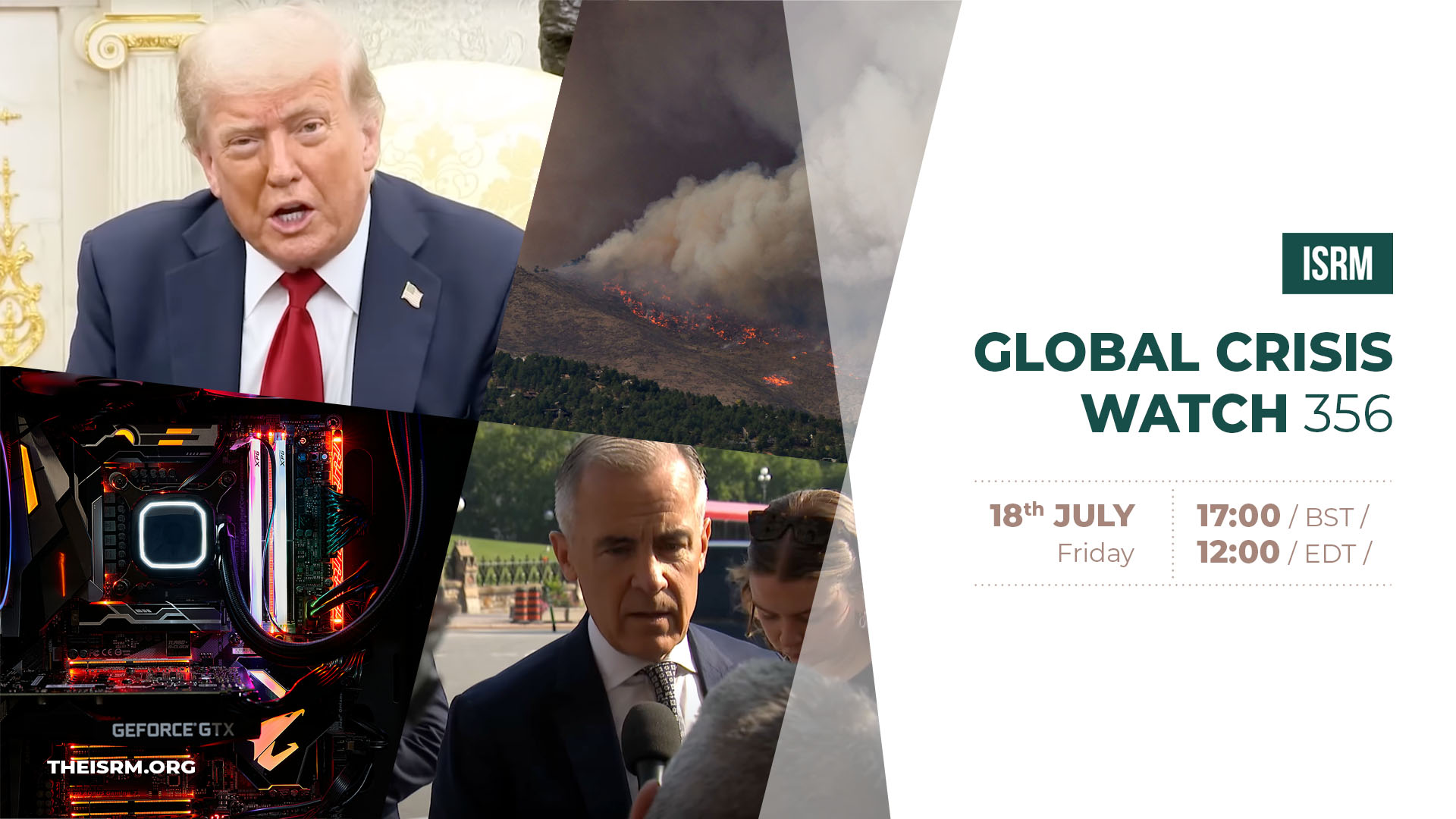
You are invited to join us for Global Crisis Watch 356, on Friday, July 18th at 17:00 BST / 12:00 EDT.
The highlighted topics will include:
Trump Pledges Weapons to Ukraine, Sets 50-Day Deadline for Russia and Says He’s ‘Not Done’ With Putin
In a series of recent developments, President Donald Trump has signaled a cautious but potentially shifting stance on Ukraine and Russia. While affirming support for Ukraine’s defense, Trump stated he is “not looking” to send longer-range missiles capable of reaching deep into Russian territory, such as Moscow or St. Petersburg. Despite this, conversations are ongoing between the US, Ukraine and European allies about other advanced weapon systems. Trump emphasized that he is “on humanity’s side”, distancing himself from explicitly backing either Ukraine or Russia.
Trump said he is “disappointed but not done” with Russian President Vladimir Putin and confirmed a 50-day window for Russia to reach a ceasefire agreement – or face harsh economic sanctions. This delay has drawn criticism, particularly from European allies and Ukrainians, who fear Russia could use the time to intensify its summer offensive. Kyiv residents expressed cautious optimism about new US aid, especially air defense systems like Patriot missiles, but skepticism remains about the overall impact and Trump’s consistency.
While the weapons pipeline is expected to move faster thanks to European funding and stockpiles, details are unclear. NATO Secretary General Mark Rutte confirmed that the aid package may include both defensive and offensive systems, coordinated by the Pentagon and Supreme Allied Command.
Meanwhile, Russia continues its offensive in eastern Ukraine, trying to expand its foothold beyond the 20% of Ukrainian territory it already holds. Chatham House analysts warn that Putin will respond more to actions than words, and so far, US follow-through remains uncertain.
European officials welcomed Trump’s renewed engagement, though some raised concerns over the 50-day delay and the risk it poses. The move signals a shift in tone, but analysts and allies remain unsure if it marks a lasting strategic change.
Carney Warns of Tariffs but Vows to Defend Canadian Interests in US Talks
Canadian Prime Minister Mark Carney has indicated that a new trade deal with the United States may include some tariffs, acknowledging the likelihood of compromise with President Trump’s tariff-driven trade approach. Carney noted that all of Trump’s prior trade agreements, including those with surplus partners like the UK, have involved some level of tariffs. With no clear signs that the US will fully abandon this strategy, Canada may need to accept levies as part of securing a broader agreement.
The warning comes as Trump plans to raise tariffs on Canadian goods from 25% to 35% starting 1st August, citing national security and Canada’s role in addressing fentanyl trafficking. While most trade between the two countries remains tariff-free under the US-Mexico-Canada Agreement (CUSMA), certain sectors – like steel, aluminum, autos and now potentially pharmaceuticals, lumber and copper – have been hit with so-called Section 232 tariffs. These levies, rooted in US law, allow protectionist measures on goods deemed security threats.
Carney emphasized that Canada continues to benefit from near “free trade” on most goods thanks to increased CUSMA compliance, now at 91% of exports. However, he acknowledged the damage sector-specific tariffs have caused, particularly to the steel industry, which has seen a 30% production decline.
While some view Carney’s stance as pragmatic, opposition leader Pierre Poilievre called it a concession to US pressure. Business leaders suggest the tariffs may be temporary, possibly negotiable when CUSMA comes up for review next year. Trump, meanwhile, insists that his letters outlining tariff changes are the deals themselves, declaring there’s “nothing left to negotiate”.
If no deal is reached by August, Carney has warned Canada could impose higher counter-tariffs, but hopes remain for a compromise that avoids further escalation. The ongoing talks highlight growing economic friction between two close allies navigating shifting political and trade realities.
US-China Tech Rivalry Intensifies as Nvidia Returns to Chinese AI Market
Nvidia CEO Jensen Huang recently praised China’s rapidly advancing artificial intelligence (AI) models and announced plans to resume shipments of Nvidia’s key H20 AI chips to Chinese companies after a US-imposed export ban was eased. This development signals China’s increasing role in shaping the global AI landscape and the challenge it poses to traditional US tech dominance.
Chinese AI firms such as DeepSeek, Alibaba, Tencent and Baidu have developed world-class AI models that emphasize cost-effectiveness and accessibility. Many of these models use an open- source approach, allowing developers free access to the underlying code, which accelerates innovation and adoption. This contrasts with the more proprietary strategies of US firms like OpenAI, which have kept their models closed-source.
The lifting of export restrictions on Nvidia’s AI chips follows ongoing US-China trade negotiations, including talks over rare earth mineral exports critical for tech manufacturing. Nvidia’s inability to sell advanced chips in China since April 2024 resulted in billions of dollars in lost sales, while Chinese companies like Huawei and domestic chip producers have seized the opportunity to advance their own AI hardware capabilities.
Huang warned that without full access to China’s vast and growing AI market, US tech giants risk losing their leadership in AI innovation. China’s focus on producing cheaper, widely accessible AI solutions is revolutionizing the sector by broadening the user base and driving global AI progress.
This shift represents a broader competition between the US and China, where China is not only catching up but also setting new standards in AI affordability and openness. By fostering an open-source ecosystem and investing heavily in AI infrastructure, China aims to challenge US dominance and reshape the future of artificial intelligence worldwide.
Wildfire Smoke Triggers Health Alerts Across Canada and US as Climate Risks Rise
Wildfire smoke continues to trigger widespread air quality alerts across Canada and the northern United States, underscoring the growing health and political challenges posed by increasingly severe climate-related events. Environment Canada has issued warnings for much of Ontario, with Toronto recently ranking among the cities with the worst air quality globally. In the US, alerts are also in effect in cities like Chicago and northwest Indiana, where officials have urged vulnerable groups – including children, the elderly and people with chronic conditions – to limit outdoor exposure.
Prime Minister Mark Carney is set to meet with emergency responders in Ottawa as wildfires rage across Manitoba, Saskatchewan, northern Ontario and Newfoundland. Over 30,000 Canadians have already been forced to evacuate in recent months. In Newfoundland, fires doubled in size overnight, destroying homes and prompting further emergency declarations.
Scientists consistently link the rise in wildfire frequency and intensity to climate change, with Canada warming at twice the global average and Arctic regions heating nearly three times faster. Despite clear evidence, the increasing demands placed on emergency systems are being compounded by political decisions south of the border.
US President Donald Trump’s ongoing policy of dismantling FEMA (the Federal Emergency Management Agency) is raising serious concerns about America’s future disaster response capacity. Reduced federal resources and staffing have already weakened FEMA’s ability to respond to high-impact events, leaving local and state governments struggling to cope with mounting environmental crises like wildfires and extreme weather. As climate events grow in scale and frequency, experts warn this policy shift threatens national resilience and public safety.
The wildfire crisis has also spilled into US-Canada political discourse. Several US lawmakers recently complained about cross-border smoke impacting American summer plans. In response, Manitoba’s premier accused them of trivializing a deadly emergency affecting thousands.
These developments reflect the interconnected nature of climate impacts – and the growing need for coordinated, well-resourced disaster response on both sides of the border.
Plus, all the stories that are catching our attention wherever we live in the world. Feel free to join us and add your voice to the conversation.
