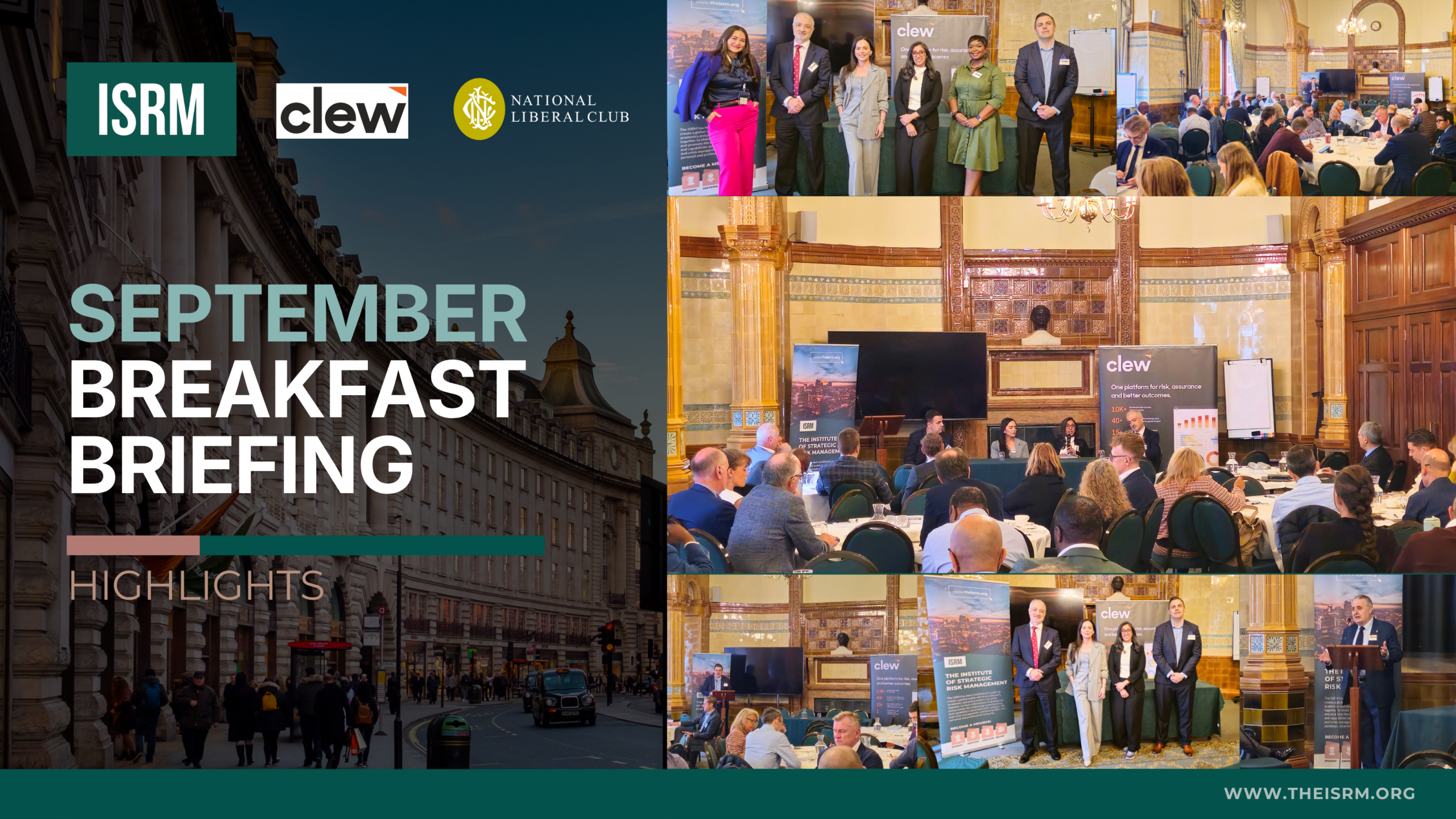
ISRM September Breakfast Briefing Highlights
How do leaders make good decisions when certainty is impossible?
That question was at the heart of our latest ISRM Exclusive Breakfast Briefing – Strategic Decision-Making in an Uncertain World, held at the National Liberal Club.
Bringing together leaders from across risk, resilience, security and business, the discussion explored what organisations really need when information is incomplete, circumstances are changing and there is no obvious answer.
At the end of the morning, participants were asked to share something they had learned and one message they would take away.
Five themes came through particularly strongly.
Risk has a communication problem
One message surfaced repeatedly:
Risk management needs to move from administration to management.
Risk professionals can have sophisticated frameworks, detailed registers and extensive data, but none of that creates value if the business cannot understand what it means.
The discussion reinforced the importance of communicating risk in business language, challenging assumptions and moving away from presenting risk purely as something negative.
Risk is inherent in business. Growth, innovation and change all involve uncertainty.
The role of risk management is therefore not simply to catalogue what could go wrong. It is to help leaders understand uncertainty well enough to make better decisions.
That also means recognising opportunity. Effective risk management can reduce adverse impacts, protect reputation and give organisations greater confidence to act.
Preparation must be tested, not assumed
If one subject came through loudly during the morning, it was training and exercising.
Scenario planning, exposure to real-world experience and decision-making training were all raised repeatedly.
One participant summarised it simply:
“Test, test and test again.”
Plans provide structure, but organisations only discover whether those plans really work when people, assumptions and decision-making are put under pressure.
Testing also helps reduce the potential for “shock and awe” when something unexpected happens. People who have practised operating with incomplete information are better prepared when the scenario is no longer an exercise.
But preparation is not only technical.
As another participant put it:
“When a crisis occurs, this is not the time to swap business cards.”
Relationships, networks and trust need to be built before they are needed.
The human element cannot be engineered away
Culture, communication, trust, challenge, ownership and clear command structures appeared throughout the discussion.
Technology can provide information. Frameworks can structure decisions. Governance can establish responsibility.
But eventually, someone has to make the call.
That makes decision-making capability itself an important component of organisational resilience.
Several participants questioned whether organisations invest enough in preparing people to make difficult decisions under pressure.
Training leaders to challenge assumptions, understand consequences and act with incomplete information can be just as important as developing the process around them.
Resilience is collaborative
Another strong message was the value of sharing different perspectives.
Every organisation operates within a different environment. Its people, dependencies, technology, scale, culture and risk tolerance will be different.
There is therefore rarely a universal answer to resilience.
What organisations can do is learn from one another.
Participants repeatedly highlighted the value of networking, collaboration and exchanging perspectives across disciplines.
Sometimes the person who helps us see a problem differently is precisely the person who does not work in our own field.
That is also an important part of ISRM’s role: creating spaces where disciplines, sectors and experiences can come together around common challenges.
Risk can enable, not simply constrain
Perhaps one of the most important shifts discussed during the morning was moving away from the idea that good risk management is principally about avoidance.
Businesses exist because they take risk.
The more useful question is whether leaders understand the risks they are taking, whether those risks sit within their tolerance and whether the organisation is resilient enough to deal with the consequences when circumstances change.
Seen through that lens, risk management becomes an enabler.
It can help organisations protect reputation, make more informed strategic choices and pursue opportunity with greater confidence.
From frameworks to decisions
Across all of the discussion, one conclusion connected the themes.
Resilience is ultimately about the ability to make good decisions when the answer is not obvious.
Frameworks matter. Plans matter. Technology matters.
But so do communication, relationships, experience, challenge and trust.
A huge thank you to our host Noel Hadjimichael FRSA and our speakers Tania Carvalho, Rina Singh, MBCI, Patrick Parker and Richard Brooks for leading, moderating and challenging such a valuable conversation.
Our special thanks also go to Clew, The Defence & Security Circle and the National Liberal Club for their partnership and support.
Most importantly, thank you to everyone who joined us and contributed so openly to the discussion.
Because resilience is not just about having the right framework. It is about having leaders who can make the right call when the answer is not obvious.

About Clew
Clew is a modern risk and assurance platform that helps organisations connect strategy with the risks, controls, assurance activity and actions that shape delivery.
Rather than treating risk as a standalone register, Clew creates a clear line of sight from organisational objectives through to the exposures that could affect them, the controls that matter most, and the evidence leaders need to make informed decisions.
Used by organisations across government, regulated industries and complex enterprises, Clew brings risk, assurance, compliance, audit and business continuity into one connected platform. It is designed to be practical, flexible and easy to adopt, helping teams move beyond reporting activity towards clearer insight, stronger accountability and better business performance.
At its core, Clew helps organisations understand what matters, where confidence is weak, what has changed and what needs to happen next.
About The Defence & Security Circle
The Defence & Security Circle is a leading UK forum dedicated to advancing dialogue on defence, national security and resilience. Bringing together senior leaders from government, the armed forces, industry, academia and the wider security community, the Circle provides a trusted platform for informed discussion on the strategic issues shaping today’s increasingly complex global environment.
Through high-level events, expert briefings and collaborative engagement, the Defence & Security Circle promotes knowledge sharing, thought leadership and cross-sector collaboration to strengthen national resilience, inform strategic decision-making and support effective responses to emerging risks and security challenges.
