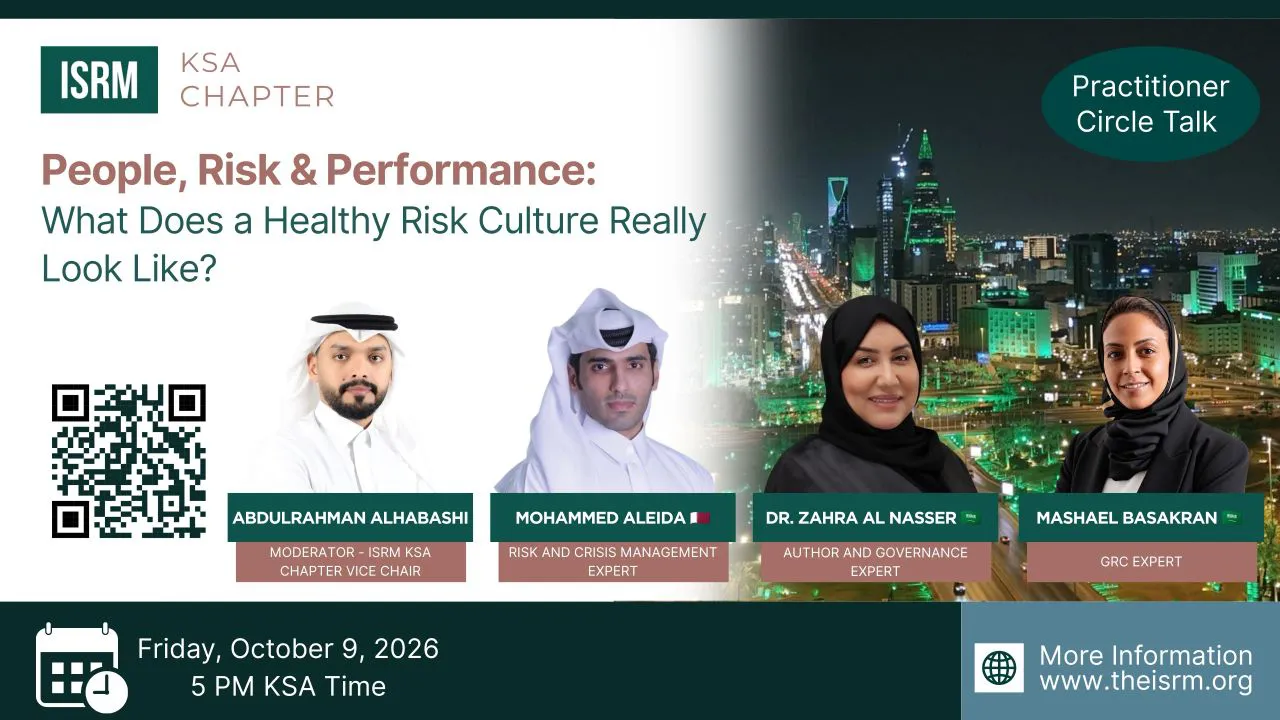
KSA Chapter – People, Risk & Performance: What Does a Healthy Risk Culture Really Look Like?
Policies, controls, governance structures and risk frameworks set important boundaries for organisations. But when the situation is unclear, and the rulebook offers no obvious answer, people still have to make the call.
How do they respond to uncertainty? Do they feel comfortable speaking up or challenging assumptions? How is accountability understood when something goes wrong? And do people learn from experience, or simply become more cautious?
These are some of the questions at the heart of risk culture.
A healthy risk culture shapes how people make decisions, raise concerns, respond to changing circumstances and understand their responsibilities. It also has a direct connection to organisational performance. When people can make sound decisions, take appropriate risks and identify opportunities, organisations are better placed to respond effectively when conditions change.
Understanding risk culture therefore goes beyond measuring behaviours or completing an assessment. It means looking at the human and organisational environment behind those behaviours – including leadership, governance, accountability and how decisions are made in practice.
These are the issues the ISRM Kingdom of Saudi Arabia Chapter will explore in its next Practitioners Circle Talk, delivered in Arabic.
The conversation will bring together practitioners with different areas of expertise to examine risk culture from practical perspectives, including leadership, governance, human behaviour, accountability and decision-making.
Joining the conversation:
- Abdurrahman AlHabashi – Moderator | ISRM KSA Chapter Vice Chair
- Mohammed Aleida – Risk and Crisis Management Expert
- Dr Zahra Al Nasser – Author and Governance Expert
- Mashael Basakran – GRC Expert
Join the ISRM KSA Chapter for an open and practical conversation about the people and behaviours behind effective risk management.
